Benefits decisions rarely happen in a vacuum. Every year, HR leaders are asked some version of the same question: Are our benefits competitive? And are we investing in the right places?
With healthcare costs rising and workforce expectations evolving, answering that question requires more than intuition. For example, the 2025 Employer Health Benefits Survey found that average employer-sponsored family premiums reached $26,993, continuing a steady upward trend in benefits costs.
This is where employee benefits reports and benchmarking studies become invaluable. These reports compile data from thousands of organizations to reveal how employers design their benefits programs, how employees use them, and how costs are changing across the workforce.
When used correctly, these reports help HR and finance leaders:
- Understand market trends
- Evaluate whether benefits offerings are competitive
- Identify cost drivers
- Guide strategic planning
But not all reports serve the same purpose and understanding how to use them effectively can turn industry data into meaningful operational insight.
Industry Reports vs. Benchmarking Reports
When HR teams begin researching benefits data, they typically encounter two types of reports: industry trend reports and benchmarking reports. While they sound similar, they serve different strategic purposes.
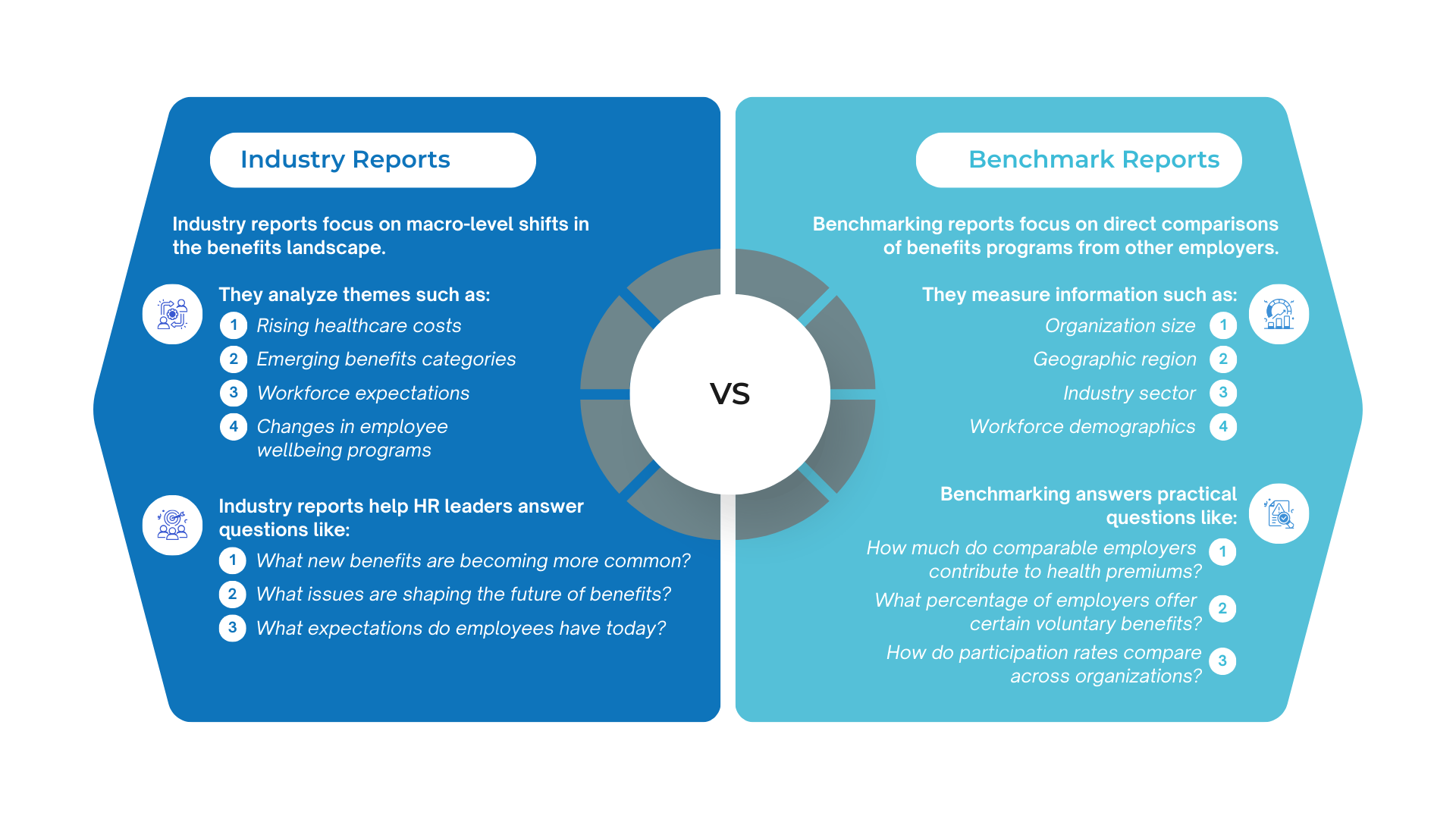 In short:
Industry Reports: Understand trends shaping the benefits landscape
Benchmarking Reports: Compare your organization’s benefits against peers
The most effective HR teams use both together; industry reports to understand the direction of benefits strategy, and benchmarking reports to validate internal decisions.
Recommended Sources for Employee Benefits Reports
The benefits landscape is supported by a number of highly respected research organizations. The following reports are among the most widely used by HR leaders and benefits consultants.
1. Gallagher’s benchmarking research is based on survey data from more than 4,000 organizations and provides insights into medical benefits, voluntary offerings, pharmacy trends, and absence management strategies. This report is particularly useful for understanding how organizations structure benefits to support employee wellbeing, retention, and cost management.
2. The Aflac WorkForces Reportfocuses on employee sentiment and benefits satisfaction. It explores topics such as employee understanding of benefits, financial stress among workers, and the perceived value of voluntary benefits. HR leaders often use this report to understand how employees actually experience their benefits programs.
3. Published by the U.S. Office of Personnel Management, this survey provides insights specifically related to federal employee benefits participation and preferences. For public sector organizations, it offers valuable context on federal workforce benefits trends, participation rates, and employee satisfaction with benefits programs.
4. The Bureau of Labor Statistics produces one of the most widely cited datasets on benefits availability and participation. This research helps HR teams understand which benefits are most commonly offered in the U.S., participation rates across industries, and trends in retirement, healthcare, and paid leave programs.
5. MetLife’s research explores the relationship between benefits, employee wellbeing, and workplace satisfaction. These insights are particularly helpful when evaluating how benefits programs influence employee engagement and retention.
6. The SHRM survey provides one of the most comprehensive views of which benefits employers are offering and how those offerings are changing over time. It also allows organizations to compare benefits data by industry, size, and location.
7. The Kaiser Family Foundation survey is widely regarded as the authoritative source for healthcare cost trends in employer-sponsored benefits. It tracks premium costs, employer contributions, plan design changes, and employee cost-sharing trends across the U.S. workforce.
8. Mercer’s benchmarking studies provide global insights into benefits strategy, workforce planning, and total rewards design. Organizations often use these reports to evaluate how benefits support broader talent attraction and retention strategies.
How HR and Finance Teams Can Use These Reports
Benchmarking reports are most powerful when used as part of a structured decision-making process. Here is a simple three-step approach HR and finance teams can use to translate external data into actionable insight.
Step 1: Establish Your Baseline
Before comparing your benefits against the market, organizations need a clear understanding of their current internal data. This includes:
- Benefits enrollment rates
- Employer and employee contributions
- Total benefits spend
- Participation in voluntary benefits
Establishing this baseline allows HR teams to accurately compare their programs against external benchmarks.
Step 2: Compare Against Market Data
Next, HR and finance teams review benchmarking reports to identify how their benefits strategy compares to similar employers. Key questions include:
- Are our employer contributions aligned with market averages?
- Are we offering benefits employees increasingly expect?
- Are there programs with low participation that may need redesign?
This step helps organizations understand where they are aligned with the market—and where gaps exist.
Step 3: Translate Insights into Strategy
The final step is turning data into action. Insights from benchmarking reports can support decisions such as:
- Adjusting employer contribution strategies
- Introducing new voluntary benefits
- Improving employee communication about benefits
- Evaluating overall benefits spend
When HR and finance teams collaborate on these insights, benchmarking reports become a powerful tool for aligning benefits strategy with organizational goals.
Turning Benefits Insights into Action
Benefits benchmarking reports provide valuable context, but they are only part of the picture. To truly act on those insights, organizations need accurate internal data, reliable reporting, and clear visibility into their benefits programs.
Bentek helps public sector organizations bring those pieces together by connecting benefits enrollment, payroll data, and reporting into a single platform. The result is clearer insight into benefits participation, payroll accuracy, and program performance.
👉 Request a demo to see how Bentek helps HR teams turn benefits data into smarter decisions.