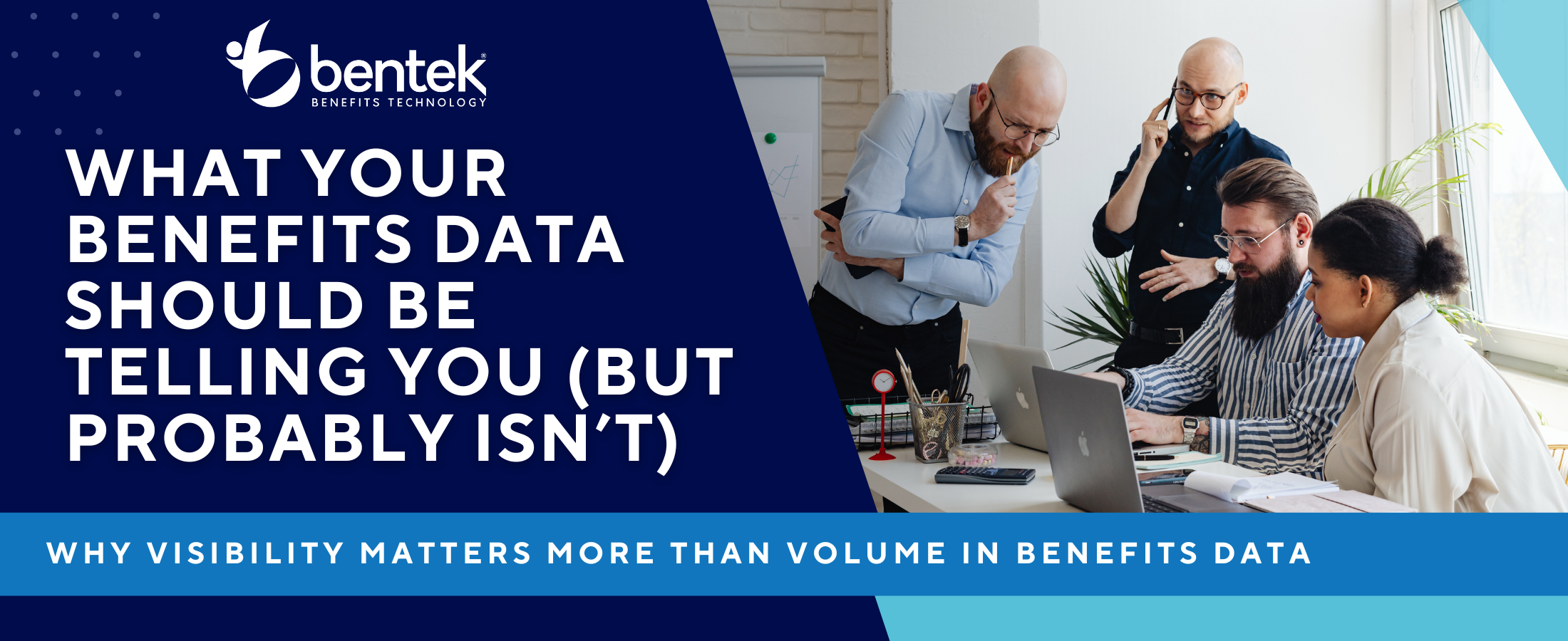
Every HR team has benefits data (enrollments, elections, eligibility records, payroll deductions, life events…). But having benefits data and understanding benefits data are two very different things.
Across government and education organizations, HR teams often collect massive amounts of information through HR software and benefits administration systems, yet still struggle to answer basic operational questions. Not because the data is missing but because it isn’t visible, connected, or usable in meaningful ways.
This gap is where inefficiency, risk, and rework quietly take root.
The Problem Isn’t a Lack of Data. It’s a Lack of Visibility.
Most HR Software environments still rely on a mix of systems, spreadsheets, and manual reconciliation. That’s not a team problem, it’s a systems problem.
One reason it persists is that HR time gets consumed by operational tasks. SHRM has cited survey results showing 60% of HR professionals’ time going to administrative/maintenance work rather than strategic efforts (based on a BambooHR survey referenced by SHRM).
And it’s not just HR. Payroll processes, too, often remain manual-heavy. Strada Global reports that 47% of payroll processes among surveyed companies are still “mired in manual work.”
What Strong Benefits Data Visibility Actually Looks Like.
Effective benefits data should help HR leaders uncover not just what happened, but what matters operationally. Useful insights include:
-
Where eligibility errors tend to originate
-
Which plans or employee groups generate the most changes
-
How often payroll corrections follow benefits activity
-
Whether dependents and eligibility data remain consistent
-
Which processes still rely on manual oversight
These kinds of indicators help HR teams anticipate issues instead of reacting after the fact. This shift separates tactical work from strategic influence.
Research in HR analytics consistently finds that organizations can gain significant advantages by embracing data-driven approaches, yet many organizations underutilize these capabilities due to integration and data quality challenges (ResearchGate).
Why These Gaps Persist in Public Sector HR.
Benefits administration in government and education is inherently complex. Multiple employee groups, varied eligibility rules, compliance requirements, and budget constraints all create friction points for HR teams.
That’s why manual, disconnected approaches often remain in place long after they stop serving the organization effectively.
Complexity also increases when HR teams don’t have the benefit of connected systems. Research into HR automation and workflows finds that automation improves accuracy, compliance, and efficiency while reducing manual effort — but implementation barriers like integrations and data harmonization still slow progress in many organizations (Enterprise Machine Assistant).
Compared to private sector norms, public sector HR teams also face unique resourcing and regulatory constraints, further magnifying the impact of data visibility gaps.
Benefits Data as an Operational Early-Warning System.
When benefits data is centralized and consistently validated, it becomes more than an archive: it becomes an early-warning system.
Instead of asking “What went wrong?”, HR teams can ask “Where are trends heading?” and “What needs attention now?”:
-
Are certain eligibility updates frequently disputed?
-
Do payroll corrections cluster around specific benefits plans?
-
Are manual reconciliation tasks cascading into audit risk?
With analytics and automation supporting benefits workflows, HR leaders can identify these patterns sooner, spend less time on repetitive tasks, and more time on strategic workforce planning.
SHRM research highlights how automation enables HR teams to improve responsiveness and reduce administrative workload, freeing HR professionals to focus on higher-value work.
Why Timing Still Matters, Even for Evergreen Planning
Benefits activity isn’t shut off after open enrollment ends. Elections change, eligibility shifts, life events occur, and payroll needs to stay accurate.
That’s why institutionalizing benefits data visibility is a year-round priority. Teams that treat benefits administration as an ongoing strategic capability rather than a seasonal checklist enter periods of operational change with clarity rather than urgency.
This isn’t aspirational. It matches what research finds about digital transformation in HR: organizations that adopt analytics and automation unlock better strategic decision-making and operational outcomes, though many still lag in prioritizing process transformation (Cornerstone).
A More Mature View of Benefits Administration
Modern benefits administration is not about collecting more data; it’s about leveraging data that’s accurate, connected, and actionable.
That looks like:
-
Fewer manual reconciliation steps
-
Consistent eligibility and payroll updates
-
Clear audit histories
-
Reliable trend reporting
For public sector HR teams especially, this maturity isn’t optional, it’s what enables small teams to manage complex programs with confidence.
The Question Worth Asking.
If your benefits data disappeared tomorrow, what would you lose?
If the answer is clarity, confidence, or control, it may be time to rethink not how much data you collect, but how well your organization understands it.
Because the most valuable benefit of good benefits data isn’t reporting, it’s trust in the systems that support your people and your mission.
See What Better Benefits Data Visibility Looks Like.
If your organization is ready to move from reacting to benefits issues to anticipating them, see how Bentek supports public-sector HR teams with clearer data, fewer manual processes, and year-round operational insight.
👉 Explore the Bentek platform with a guided demo – click here!